

Hello,
This month I did something tedious so you do not have to: I sat down with the published fee schedules of every venue we track and worked out what it actually costs you to hold a one dollar contract.
Two things surprised me.
The first is that the venues disagree completely about who should pay. Some charge you when you trade. Some charge you only if you win. Some charge you nothing and make their money elsewhere.
The second is that, once you do the arithmetic, most of them are charging along the same curve. They take the most from you when nobody knows the answer, and almost nothing once the crowd has made up its mind. We have started calling that the uncertainty tax.
Four ways to charge you for the same dollar
The house margin. The bookmaker's way. Both sides are priced so the pair costs a little more than a dollar, and the house keeps the difference. At the familiar price of -110 on both sides, the pair costs $1.048.
The gap between buying and selling. On an exchange you trade with another person, not the house. If you can buy at 51 cents and sell at 49, that gap is a real cost to you, but the venue never touches it. It goes to whoever was patient enough to wait on the other side.
A fee per trade. Usually charged only to the person who takes a price that is already sitting there, not the person who posted it and waited.
A cut of your winnings. Nothing to trade, then a share of your profit when you are right.
Most venues mix these. What matters is which one carries the weight, and who ends up paying it.
| Venue | Where the cost sits | Who pays | When |
|---|---|---|---|
| Kalshi | fee per trade, plus the gap | whoever takes the price | on every trade |
| Polymarket | fee per trade, plus the gap | takers, with part paid back to patient traders | on every trade |
| Polymarket US | fee per trade, plus the gap | takers, with a rebate to patient traders | on every trade |
| Opinion | fee per trade, plus the gap | takers, half paid back to patient traders | on every trade |
| Novig | the gap, plus a fee once a game is live | takers, during live play | on live trades only |
| PredictIt | 10% of each winning profit, 5% of withdrawals | winners, then anyone cashing out | when you win, and when you withdraw |
| sx.bet | the gap, plus 5% of profit on winning parlays | parlay winners | on winning parlays only |
The uncertainty tax
Here is the formula almost everyone uses:
fee = rate × contracts × price × (1 - price)
That last part is what makes it interesting. Multiply the price by one minus the price and you get the biggest number at 50 cents, and almost nothing near 1 cent or 99 cents. So the fee is largest exactly when the outcome is a coin flip, and it nearly disappears once a contract is close to settled.
The venues differ mainly in the rate. Kalshi charges 0.07. Polymarket sets it by subject, from 0.07 on crypto down to 0.04 on politics, and nothing at all on geopolitics. Polymarket US moved to 0.0695 on September 16, which lands within a rounding error of Kalshi. Novig charges only once a game is live.
At a coin flip, taking 100 contracts at 50 cents costs $1.75 on Kalshi, $1.00 on Polymarket politics, and nothing on Polymarket geopolitics.
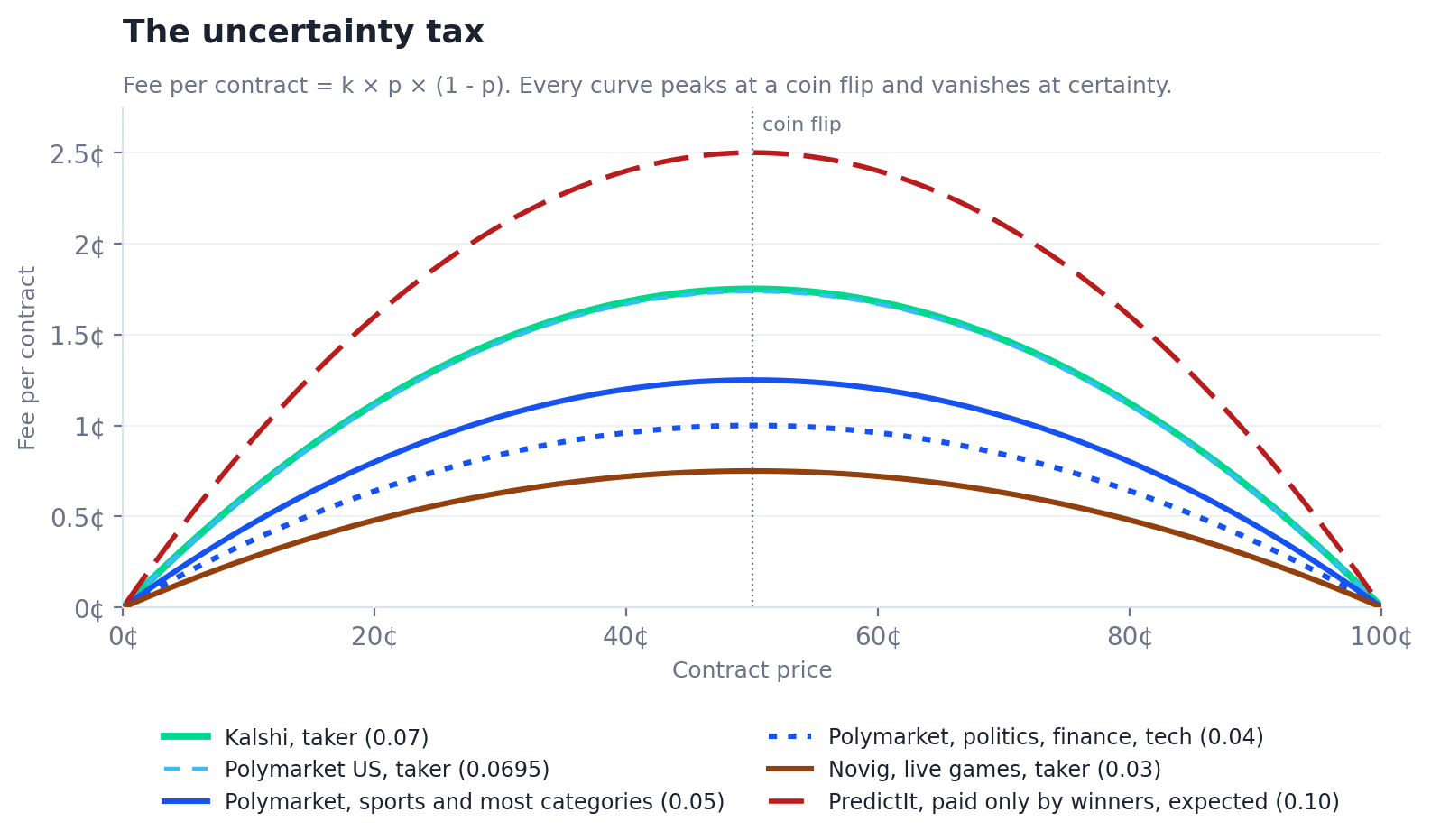
Figure 1. Every curve peaks at a coin flip and falls to nothing at certainty. Polymarket US sits almost exactly on Kalshi. The dashed red line is PredictIt, which we come to below.
There is a catch, and it favors the favorite. Measured against the contract, the curve is even: on Kalshi, 100 contracts at 10 cents and 100 at 90 cents both cost 63 cents in fees. Measured against the money you put up, it is not even at all. That 63 cents is 6.3 percent of the $10 you risked on the long shot, and 0.7 percent of the $90 you risked on the favourite.
So the cost falls hardest, per dollar risked, on people betting long shots. Long shots are already the contracts most likely to be overpriced. The fee quietly adds to that.
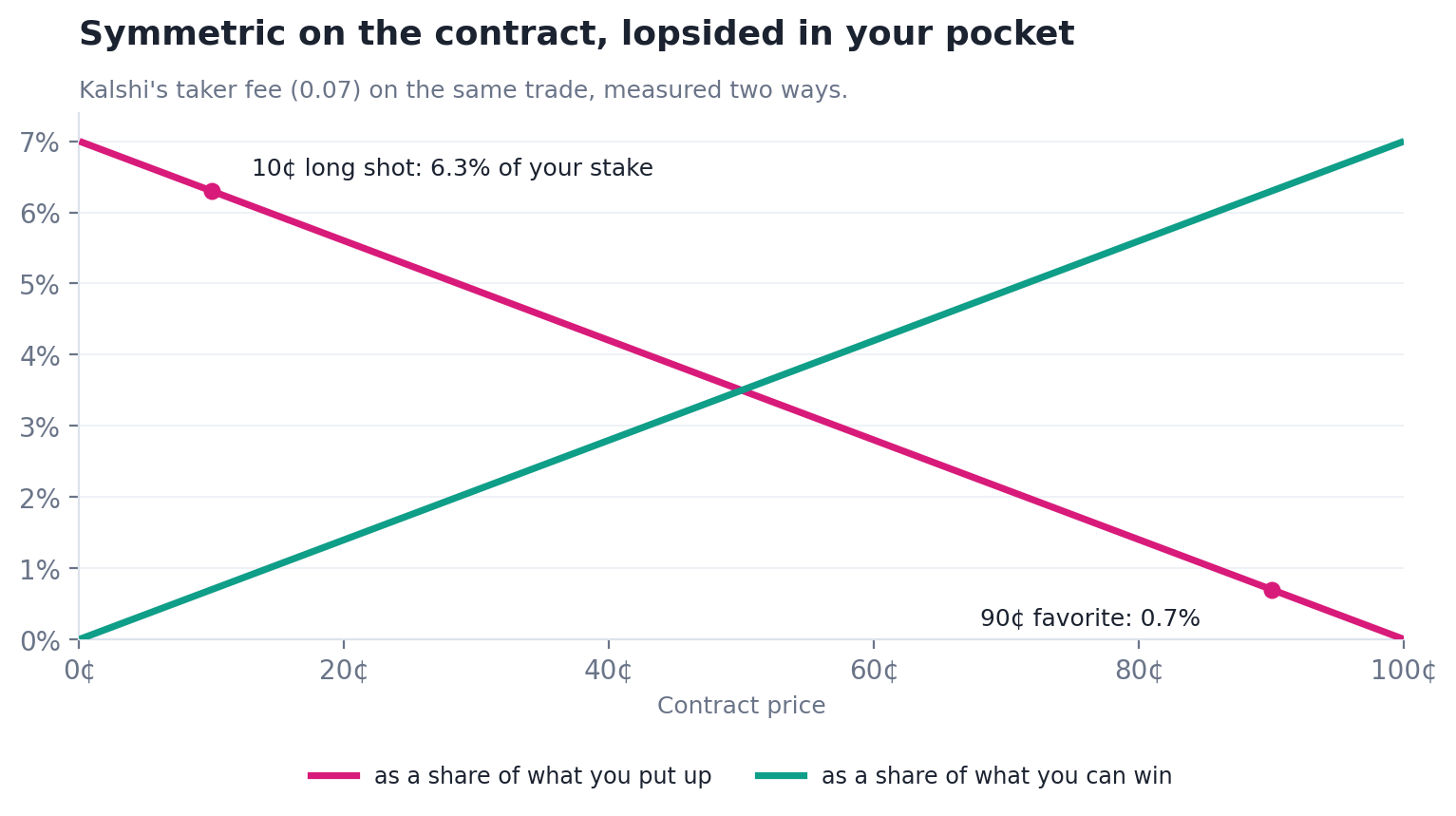
Figure 2. The same fee, measured two ways. Against what you put up, it falls hardest on the long shot. Against what you stand to win, on the favourite. The two lines cross at 50 cents.
The venues that charge only winners
PredictIt charges nothing to trade, then takes 10 percent of the profit on each winning position, plus 5 percent of anything you withdraw. sx.bet charges nothing on single bets and takes 5 percent of the profit on winning parlays.
That sounds cheaper, and in one way it is: only the people who were right pay anything. But do the arithmetic and you land back on the same curve, at a rate of 0.10, collected from the winning side alone. In other words, on average winning markets, PredictIt is the most expensive venue in this letter, not the cheapest.
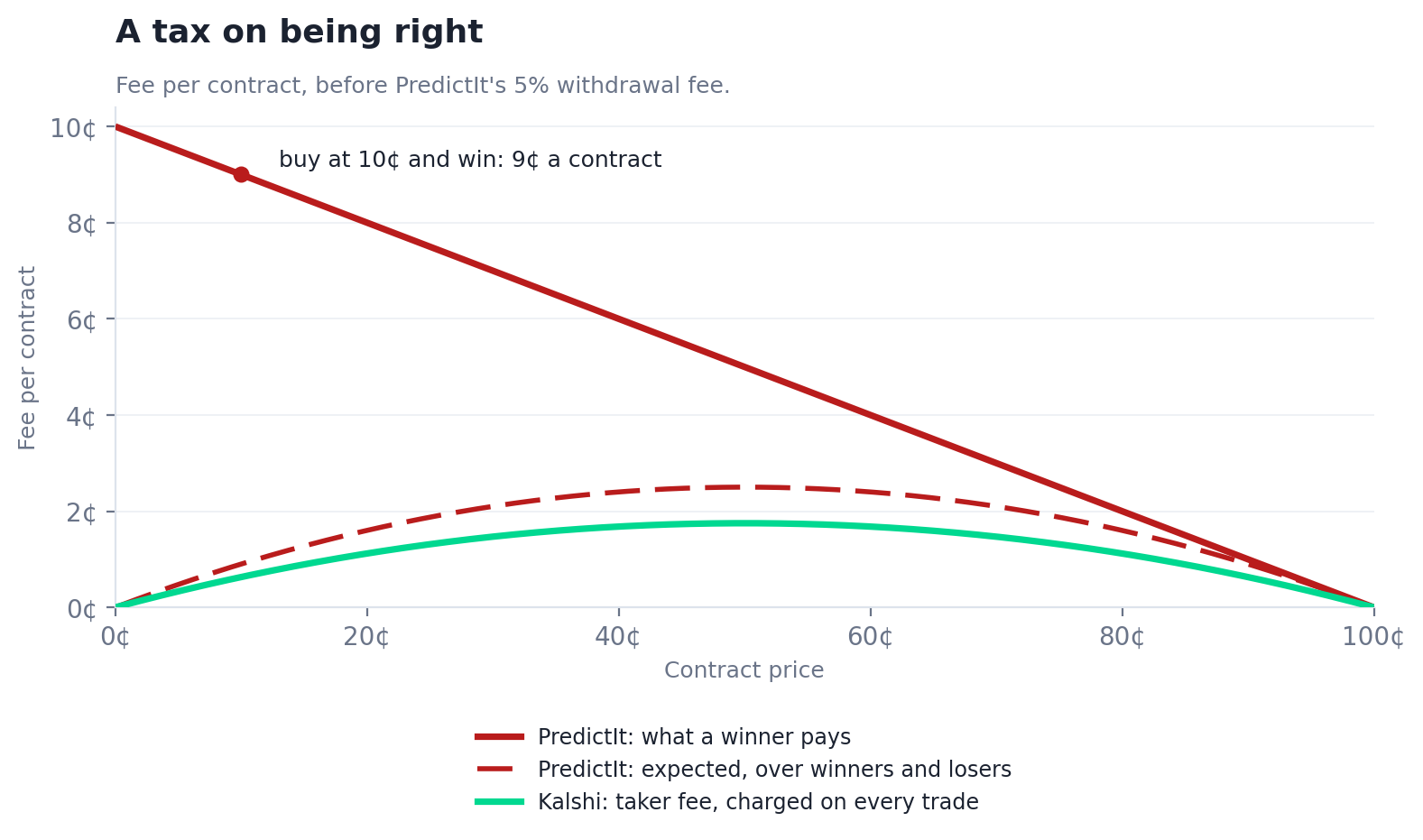
Figure 3. Win on a 10 cent contract at PredictIt and you hand back 9 cents of every contract's profit. Averaged across winners and losers, the dashed curve sits above Kalshi at every price.
The plainest way to compare is to ask how often you need to be right, on a coin flip, just to break even.
How often you must be right to break even at 50 cents
| Where you trade | How you pay | Break even |
|---|---|---|
| PredictIt | 10% of winning profit, plus 5% on withdrawal | 52.6% |
| A sportsbook at -110 | the house margin | 52.4% |
| Kalshi | 0.07 per trade | 51.75% |
| Polymarket US, from September 16 | 0.0695 per trade | 51.74% |
| Polymarket, politics | 0.04 per trade | 51.0% |
| Novig, live | 0.03 per trade | 50.75% |
| sx.bet singles, Novig before kickoff, Polymarket geopolitics | no fee | 50.0% |
The cost nobody collects
The gap between buying and selling is the cost readers forget, because no venue lists it. Our fee tracker measures it about twice a week, across markets priced between 5 and 95 cents:
What the buying / selling gap costs, by venue
| Venue | What we measure | Typical | Based on |
|---|---|---|---|
| Polymarket | gap between buying and selling | 2¢ | 54,516 readings, April to August |
| Kalshi | gap between buying and selling | 5¢ | 156,654 readings, June to August |
| Opinion | gap between buying and selling | 7¢ | 87 readings, August only |
| PredictIt | what a full set of outcomes adds up to | $1.01 | 1,765 readings, June to August |
| Novig | what a full set of outcomes adds up to | $1.00 | 48 readings, August only |
| sx.bet | charges a commission instead | not measurable in prices |
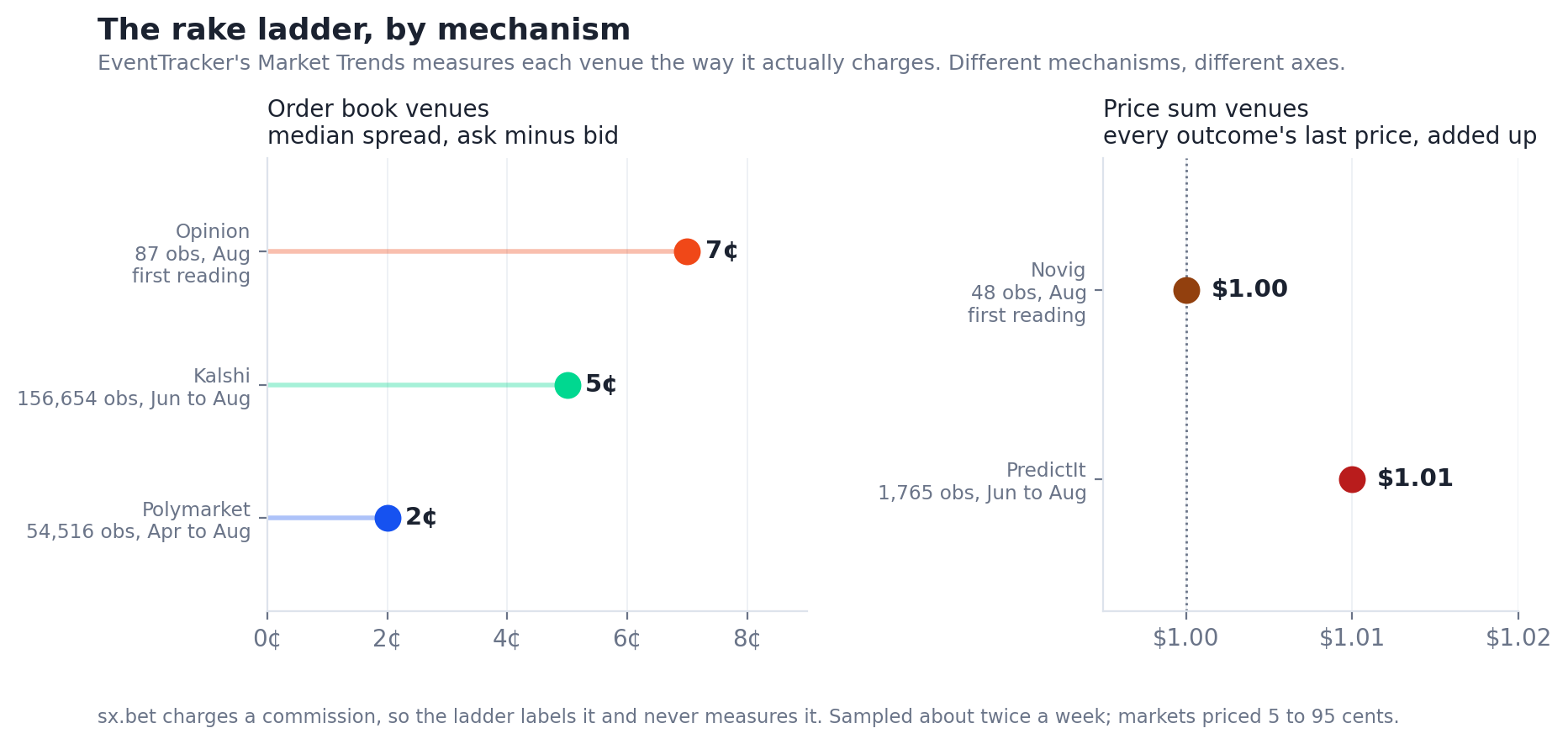
Figure 4. Gaps and price sums are different measurements, so they get different scales. sx.bet, whose cost is a commission, gets no number at all.
This isn’t a list ranked by venue quality, as it is not made on a common set of parameters. For example, a venue listing thousands of thinly traded markets will look worse on buying / selling gap lists than one whose trading sits in a few busy ones, and the Opinion and Novig rows rest on fewer than a hundred readings from a single month.
As for Novig's dollar, it adds up to exactly a dollar because every trade there is one customer matched against another, with no house in between building in a margin. That is what "no vig" means, and it is true. What it leaves out is the gap you cross to get in, and the fee once the game is live. A price with no margin in it is not a “free” trade.
PredictIt is the mirror image. Its prices add up to about $1.01,
nearly perfect, while its real cost, that 10 percent of your winnings,
never shows up in a price at all.
How long will Kalshi, Polymarket et al. be able to hold sub-sports book
house edges for? And are Opinion and Novig indeed emerging low-vig
competitors on the market? We will be following the fluctuations of fee
prices at these, and additional venues in the coming months, as the
outlines of the macro PM market keep taking shape.
Tal Ayalon Co-Founder & CEO, PodComet LLC
Fee schedules are each venue's own, as published on September 18, 2026. Venues change them, so check before you trade. Gap and price sum figures come from EventTracker's own tracking on the Market Trends tab. EventTracker is an independent, unaffiliated, display only aggregator. We take no wagers and hold no funds. Nothing here is investment or wagering advice.